Scores and protocol in Sound Art
Score
Scores organise performance actions in real time, they are not just instructions, they are actually the work itself. A score can function as both a guide and contextual framework, allowing the piece to exist is several different interpretations and performances. Unlike traditional musical notation, many sound art scores are open-ended and flexible, giving performers space to interpret actions in their own way.
Because of this, a score is never completely fixed. The same score can lead to entirely different outcomes depending on who performs it, where it is performed and how the performer responds to the environment around them.
Scores also encourages artists to think differently about performance and sound. Instead of focusing only on technical skill or musical structure, they often focus on action and process.
Protocol
A process defines a process for gathering, organising or responding to data in Sound Art. It often introduces rules that shape how work unfolds overtime. Unlike a score, which is usually connected to performance a protocol is more focused on process and method.
Protocols can involve several things like data collection or recording with environments and people. They create a structure that guides how the artwork unfolds while still leaving room for interpretation. In sound art protocols are used to explore systems behaviours and relationships between sound and space.
Why use scores?
Scores can be used as a good practice and a thinking tool. They provide a structure whilst still allowing freedom, encouraging artists to promote their performance in their own way. The same score can produce completely different outcomes depending on who performs it. This gives the power to the artists, emphasising interpretation and individuality, scores open up space for experimentation rather than fixed results.
One of the most important aspects of scores is that they give power to the performer or artist. The same can produce completely different outcomes depending on how somebody approaches it. This means the work is constantly and changing and evolving rather than remaining fixed.
Fluxus scores
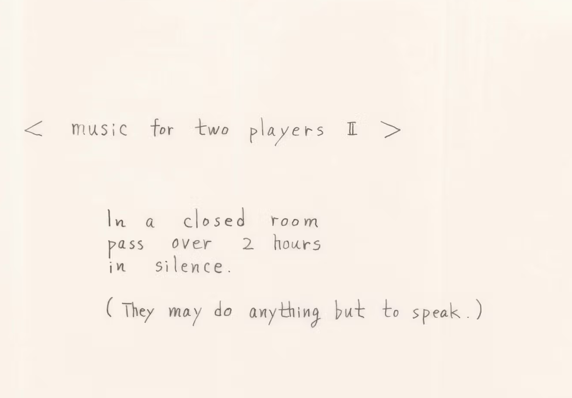
The Fluxus movement played a major role in redefining what scores could.
- Influenced by John Cage, Fluxus artists explored chance, humour and everyday actions as part of artistic practice. Instead of treating art as something separate from ordinary life, they blended everyday experiences into performances and scores.
- Internal network of artists active mainly in the 1960’s, Fluxus brought together an international network of artists musicians and performers who wanted to challenge traditional ideas about art and performance.
Example Le Monte Young – Composition number 7
One important example of this approach is Composition 1960 7 La Monte Young. The score simply instructs performers to hold two notes, B and F for a very long time.
Even though the score is extremely minimal, it completely changes the way music can be understood. Instead of focusing on melody and rhythm the piece focuses on duration and listening itself. As the notes continue overtime, small changes become noticeable.
Pieces like these show that scores do not need to be complex to create meaningful experiences. Sometimes the simplest instructions open up the most space for experimentation and reflection.
Through researching scores, sensory perception and listening I have started thinking more deeply about how I want to approach my sound piece on Inverse Effectiveness. What interests me most is how uncertainty can encourage people to listen more actively. When sounds are unclear or fragmented the listener has to focus more closely which can create a stronger sense of engagement and presence.
I am also interested in using ideas from scores and protocols to shape the process of the piece. Instead of creating something completely fixed, I like the idea of working with rules or structures that allow the sound work to change depending on the environment or performance.
Going forward, I want to continue exploring how subtle sound and duration can affect perception and make listeners more aware of their surroundings.